
Proven Technologies.
Custom-engineered for your farm.
What we install
Ground-source heat pumps, not geothermal power
Proven in the ground. Engineered for your farm. Fifty Under builds, owns, and operates ground-source heat pumps — not geothermal power plants. Geothermal often refers to two very different things. One taps very high thermal resources deep in the earth, at depths that carry real drilling risk, to bring steam to the surface and make power. The other harnesses the stable temperatures of shallow ground to provide heating and cooling. Fifty Under does the second, not the first.
Deep geothermal — making power
Drill miles down to reach rock hot enough to make steam, and run that steam through a turbine. High temperature, high drilling risk.
Shallow ground source — heating & cooling
Loop a few hundred feet into ground that sits near 50°F all year, and move that heat in or out of your buildings. No steam, no reservoir, no wildcat well.
Where the resource is
Two different maps, two different technologies
When people picture geothermal, they picture this map. It shows where the earth runs hot enough near the surface to spin a turbine — concentrated in the West, thin almost everywhere else. It is the map that decides where geothermal power plants get built.
Deep geothermal resource — where power is viable

Geothermal Resources of the United States — Identified Hydrothermal Sites and Favorability of Deep Enhanced Geothermal Systems. Source: Geospatial Data Science, National Renewable Energy Laboratory.
This is not the map that governs your farm.
Fifty Under does not drill for steam. We loop a few hundred feet into ground that holds the heat the sun put there — and that resource is not concentrated anywhere, because it is not geological. It tracks latitude, not hot rock.
The Department of Energy puts shallow ground across the country at roughly 40–70°F year-round — warmer than the winter air above it, cooler than the summer air. That gap is the entire resource, and every state on the map above has it.
So the honest version is this: ground-source works everywhere in the country, and what changes site to site is not whether the resource exists but how the system gets designed around it.
Colder ground in the northern tier means a bit more loop for the same heat — a cost input we size for, not a barrier. Warmer ground in the South shifts the advantage toward cooling and dehumidification. The real site variables are drilling conditions and how your heating and cooling loads balance across the year. Both get assessed before anyone signs anything.
How it works
The technology is proven
Heat pumps have heated and cooled buildings for decades. In a greenhouse, the same machine runs both directions across the year — pulling heat in when it's cold, pushing it out when it's not.
Ground-source heat pump
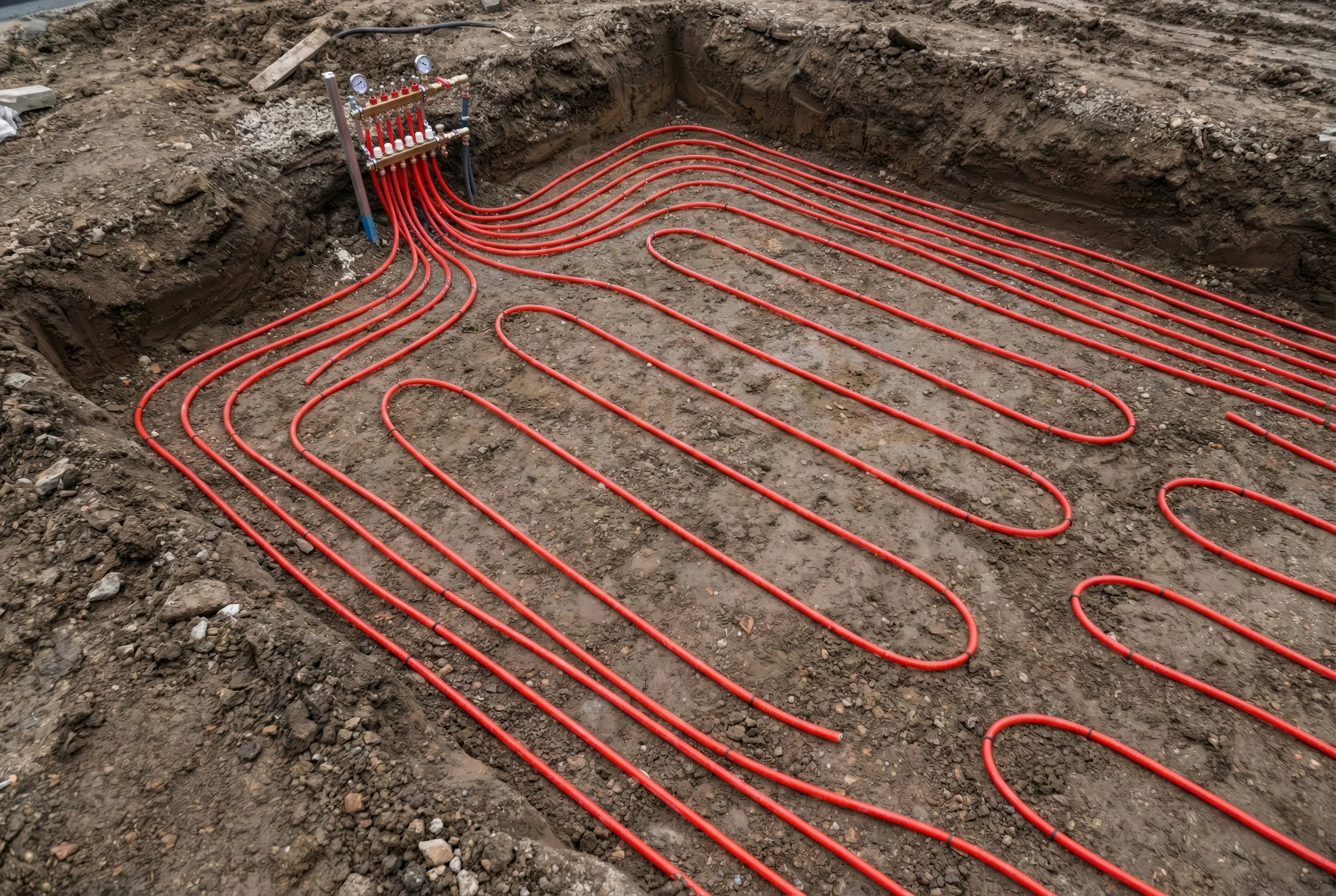
Winter: the loop extracts ground heat. Summer: it rejects building heat for cooling and dehumidification. Vertical bores where land is tight; horizontal trenches (6–10 ft) where there's room.
Air-source heat pump
Same reversible-refrigerant cycle, but it trades heat with outside air instead of the ground. No loop to install — lower upfront cost, but efficiency falls as outdoor temps drop, unlike a GSHP's stable ~50°F source.
Getting the climate right
Why vapor pressure deficit drives the design
VPD measures the drying power of greenhouse air — the gap between how much moisture the air is holding and how much it could hold at saturation. It drives transpiration more directly than temperature or humidity alone, which is why temperature and humidity have to move together. Holding your crop in the healthy band is exactly what a well-designed system is for.
Vapor pressure deficit — the healthy band
Hold the reading in the middle band and the crop transpires at its best.
Right-sizing & bivalent design
Sized for the coldest night, not the average one
We size geothermal to roughly half of your peak demand — which still covers about 90% of your annual heating energy — and back it with a small burner for the handful of extreme-cold hours a year. Oversize the geothermal and you pay for capacity you rarely use; undersize it and you're short on the one night your crop can't afford. Getting that balance right is the difference between a system that pays and one that doesn't.
Heating load duration across the year
Size geothermal to ~half of peak, back it with a small burner for the rare extreme hours — that's the design that pays.
Why it takes experts
Proven doesn't mean simple
The physics is settled — the technology is decades-proven. Sizing and designing it right for your operation is the expert part, and a system that's mis-sized or mis-designed quietly loses money for decades. That's the part we handle, so you don't have to.
Right-sized
Oversize it and you overpay upfront. Undersize it and you're short on the coldest night your crop can't afford. We size to your real loads.
Optimized mix
Sometimes the best design pairs geothermal with a small backup burner for a handful of peak days — "bivalent." We engineer the blend that actually pays off.
Matched to you
Vertical or horizontal loops, ground- or air-source, hybrid or not — the right answer depends on your site, crop, and budget. We find it.
Decades proven
Ground-source heat pumps are field-tested technology, not an experiment.
Sized to you
Engineered around your operation's actual heating and cooling loads.
Zero homework
Our experts design and right-size it — so you don't have to.